
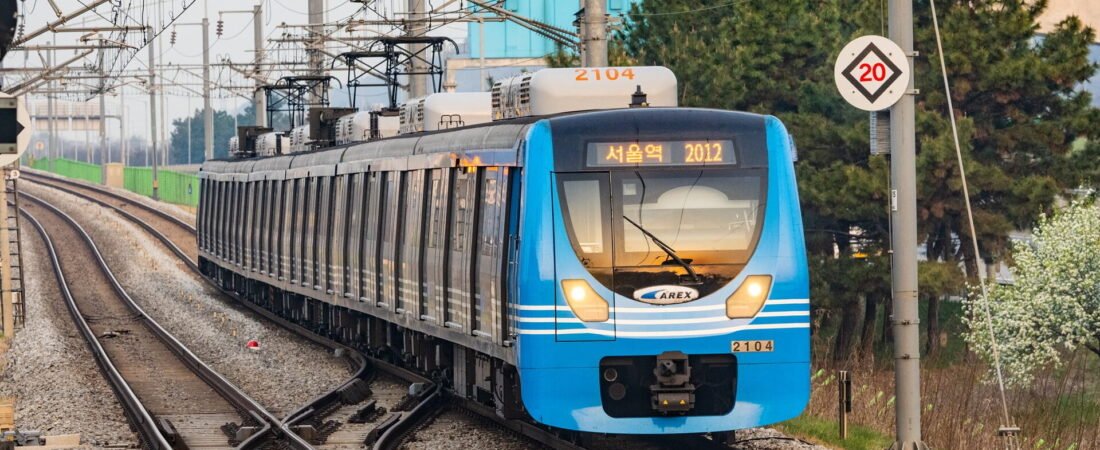
Getting from Incheon Airport to Seoul is less about finding one “best” service and more about choosing the right journey for your accommodation.
AREX can be convenient for a hotel near the railway. An airport limousine bus may save you a transfer and a long walk with your suitcase. A taxi or private transfer can make sense when several people are traveling together or your destination is awkward to reach by public transportation.
This guide compares the options, their costs, and the details worth checking before you book.
For entry documents, connectivity, airport facilities, and the steps after landing, start with my Incheon Airport Arrival Guide.
Last checked: October 30, 2026
In This Guide
🚆 1. Compare Your Airport Transportation Options
Start with your accommodation’s Korean address, then compare the journey all the way to its entrance.
| Option | Cost and Main Consideration |
|---|---|
| AREX Express | Currently advertised adult fare: ₩13,000. Reserved seating to Seoul Station; onward transportation may cost extra. |
| AREX All-Stop | Adult transportation-card fare to Seoul Station: ₩4,750 from T1 / ₩5,350 from T2. Fares depend on your destination. |
| Airport limousine bus | Examples: ₩17,000 on Airport Limousine’s direct Seoul services; ₩18,000 on K Airport Limousine route 6703. Check your particular route. |
| Taxi | Metered or service-specific fare. Compare the estimated total, including tolls and applicable surcharges. |
| Private transfer | Quoted price for the selected vehicle and service. Check what the quote includes. |
These are adult one-way examples, not universal prices. AREX Express’s advertised price can differ from its listed standard fare or a reseller’s offer. All-Stop single-use tickets cost ₩100 more than the adult transportation-card fare and require a ₩500 refundable deposit.
Compare the total for your party, including any final subway ride or taxi. For a group, the difference between individual tickets and one vehicle may be smaller than it first appears.
🚉 2. AREX Express or All-Stop?
AREX Express: A Reserved Seat to Seoul Station
The Express serves Seoul Station and the two Incheon Airport terminals, without the intermediate stops used by the All-Stop service.
The published journey times to Seoul Station are approximately:
- Terminal 1: 43 minutes
- Terminal 2: 51 minutes
It has reserved seating and requires a separate Express ticket. These times cover the train ride, not immigration, waiting for departure, walking through stations, or reaching your hotel.
I would start by comparing the Express if my accommodation were near Seoul Station or I needed to connect to another train there.
If you’re staying elsewhere, check the onward journey before paying extra for speed on the airport portion.
Searching Seoul Station (서울역) in Naver Map brings up separate listings for high-speed trains, Subway Lines 1 and 4, the Airport Railroad, and the former station building. After arriving on AREX Express, select the Airport Railroad listing as your starting point when planning onward directions.
AREX All-Stop: Useful Intermediate Stations
The All-Stop serves stations including Gimpo Airport (김포공항역), Magongnaru (마곡나루역), Digital Media City (디지털미디어시티역), Hongik University (홍대입구역), and Gongdeok (공덕역), before reaching Seoul Station.
That makes it worth checking for accommodation near those stations. For Hongdae, for example, traveling to Seoul Station on the Express would take you beyond the area before you start making your way back.
The All-Stop is a commuter-style service rather than a reserved-seat journey. Consider how comfortable you would be managing your bags if you need to stand.
When planning your journey in Naver Map, select Avoid Stairs (계단 회피) in the main map’s directions options. The separate Subway map section shows station and exit details, including whether an elevator is available. At the station, follow the elevator signs or ask staff, and allow extra time when traveling with luggage.
Check the Correct Service Before Entering
“AREX” refers to both services. Check the signs, ticket, and entrance for Express or All-Stop, rather than following the railway name alone.
When buying a ticket, select the correct airport terminal and check the conditions for changing your departure if your arrival takes longer than expected.
🚌 3. Airport Limousine Bus: Check the Stop Near Your Hotel
An airport limousine bus can simplify the journey when it stops close to your accommodation. Instead of transferring between trains, you stay on one vehicle and get off at a designated stop in Seoul.
The important comparison is bus stop to hotel entrance, not just whether a route serves the same neighborhood.
Check:
- The route and stop name
- The direction of travel
- The departure terminal and boarding location
- The walk from the stop to your accommodation
- The fare, timetable, and luggage conditions
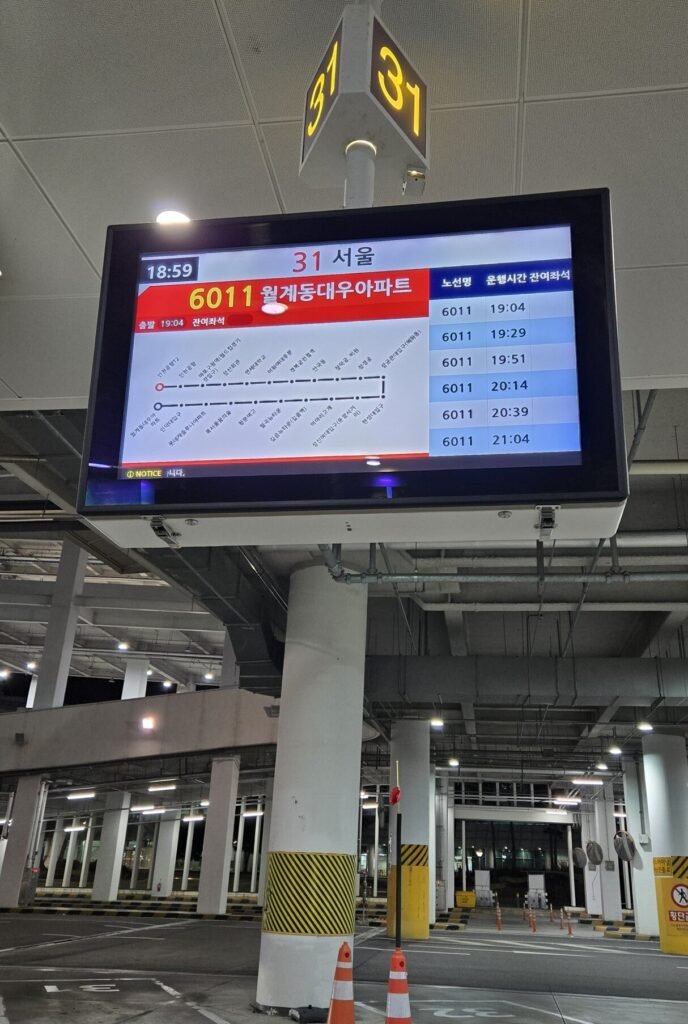
A Few Routes to Start Your Search
Airport Limousine lists 6001 and 6015 for Myeongdong (명동), and 6002 for Hongdae (홍대), Jongno (종로), Dongdaemun (동대문), and Cheongnyangni (청량리). These are starting points for checking your hotel’s location, rather than recommendations for every property in those areas.
K Airport Limousine also operates routes to several parts of Seoul. Its 6703 route serves the Gangnam (강남) and COEX (코엑스) area, including several hotels. Check the operator’s full route map against your accommodation.
For K Airport Limousine, a QR ticket must be exchanged for a paper ticket at a staffed counter before boarding at Incheon Airport. When boarding in Seoul, you can use the QR ticket directly.
Why I Would Consider the Bus
For me, the appeal is the comfortable ride and fewer changes with luggage. If my hotel were close to a stop, I would seriously consider the bus even if the train portion looked faster.
Luggage assistance can also make a difference, but check your service’s arrangements rather than expecting a porter at every stop.
The trade-off is road traffic. Leave flexibility around any reservation or onward connection after reaching Seoul.
🚕 4. Taxi or Private Transfer?
Both can provide a direct journey, but the booking and pricing arrangements matter more than the label.
Taking a Taxi After Arrival
Use the airport’s designated taxi stands. Incheon Airport advises passengers to avoid unsolicited offers from vehicles posing as taxis.
Check the vehicle type and whether the journey is metered or offered under an authorized fixed-fare service. The airport lists both regular taxis and designated services with fixed Seoul fares. Night surcharges also vary by taxi type.
Before setting off, make sure the destination is correct and clarify any questions about tolls or other charges. Keep your receipt.
For help understanding fare additions and checking charges, see How to Avoid Overpaying in Korea.
Reserving a Pickup
A pre-arranged car or taxi can be helpful when you need a particular vehicle size or want the meeting arrangements settled before flying.
Read the booking conditions for:
- Passenger and suitcase capacity
- Airport terminal and meeting point
- Flight-delay handling and included waiting time
- Tolls, parking, and other possible additions
- Cancellation conditions
- Child seats or accessibility requirements, if relevant
A reservation does not necessarily mean someone will wait indefinitely. Save the provider’s contact instructions and check when to contact the driver after landing.
📍 5. Choose by Your Seoul Destination
Seoul Station (서울역)
Compare both AREX services. The Express offers reserved seating and a shorter ride, while the All-Stop costs less.
Check where your accommodation sits relative to the station. A hotel described as “near Seoul Station” may still involve a substantial walk.
Hongdae (홍대)
Start by checking AREX All-Stop to Hongik University Station. Then look at the correct exit and the remaining walk.
A nearby airport-bus stop may be more convenient if your property is on the other side of the neighborhood or you have heavy luggage.
Myeongdong (명동)
Compare an airport bus stopping near your hotel with AREX followed by an onward connection.
The neighborhood includes accommodation at different distances from Myeongdong Station, Euljiro, and surrounding streets. Use the property’s entrance rather than a general Myeongdong map pin.
A taxi can get you close to your accommodation in Myeongdong, but pedestrian streets and vehicle restrictions may prevent a drop-off directly outside. Confirm the closest accessible drop-off point with your accommodation, especially if you have heavy luggage.
Gangnam (강남) and COEX (코엑스)
Check the exact destination first. “Gangnam” covers a broad area, and a route useful for COEX may not be convenient for a hotel elsewhere.
For rail, compare an All-Stop journey with a suitable subway connection rather than automatically traveling to Seoul Station. For the bus, check the route’s sequence of stops as well as the nearest one.
These are route-planning starting points; your accommodation, arrival time, and mobility needs determine the better fit.
🧳 6. Plan Around Your Luggage and Mobility Needs
A suitcase does not automatically rule out the train. What matters is whether the complete route works comfortably for you.
Look for:
- Elevator access at the stations you’ll actually use
- Walking involved in transfers
- The number of transfers
- The final station exit or bus stop
- Whether your accommodation has an elevator or stairs to the entrance
An accessible station entrance may be farther away than the nearest staircase. If step-free access is essential, check the entire route and ask the operator or accommodation about anything unclear.
For taxis and reserved vehicles, give the provider your actual passenger and bag count. “Four passengers” does not necessarily mean space for four large suitcases.
Consider Sending Your Bags Separately
If you’re considering luggage delivery, check the eligible accommodation, airport collection point, acceptance deadline, delivery time, and bag limits.
Keep your passport, medication, valuables, and anything you need before delivery with you. Confirm that your accommodation can receive the bags.
🌙 7. Late Arrivals and Advance Bookings
Check the last suitable service from your arrival terminal, allowing time for arrival procedures and walking to the boarding area.
A late-night bus may use a different route or stop pattern from the daytime service. Confirm that it reaches somewhere useful for your accommodation, rather than simply seeing that a night service exists.
Before paying for a timed booking, read its change and cancellation conditions. A prepaid voucher may also need to be exchanged or assigned to a departure.
If your flight is delayed, reassess the available services before leaving the terminal. Keep a backup option and your accommodation’s late-check-in instructions ready.
📱 8. Have Your Route and Apps Ready
Before leaving the airport, open your route in Naver Map or KakaoMap and save your accommodation’s Korean address.
If you plan to use a taxi app such as k.ride, Kakao T, or Uber, complete any available registration and payment setup before you need a ride. Keep Papago or Google Translate handy for communicating with a driver or asking for directions.
✅ 9. Before You Set Off
Check that you have the correct:
- Destination: accommodation name and Korean address
- Terminal: T1 or T2 on your ticket or reservation
- Service: Express, All-Stop, bus route, or booked vehicle
- Departure or meeting point
- Payment or valid ticket
- Luggage and personal belongings
The easiest journey may cost a little more or take a little longer on the road. Choose the combination of cost, walking, transfers, and comfort that works for you.
For the rest of your arrival preparation, including getting connected and finding airport facilities, use my Incheon Airport Arrival Guide.
Photo: Takeshi Aida, via Wikimedia Commons, licensed under CC BY-SA 2.0. Cropped, resized and compressed.